loader image
Eclectic Photography
Behind The Scenes: An Overview of My Cinematic Lighting  Process With Strobes – Off Camera Flash.

Behind The Scenes: An Overview of My Cinematic Lighting Process With Strobes – Off Camera Flash.

K2photographic - UK specialists in cinematic off-camera flash for horse portrait photography, dog & family portraits.

I thought I’d write a short introduction about how I got into lighting, as I personally think a bit of context is both important and useful. That said, if you’re here purely for the lighting side of things, feel free to scroll straight down to “My off-camera flash lighting in relation to cinematic lighting” I won’t be offended, much.

Although I worked in a theatre in my early 20s for a couple of years, starting out as a stagehand and eventually rigging lights and operating spotlights and sound desks, I didn’t have the benefit of any formal photography lighting training, particularly in a studio environment. My journey into lighting has mostly been self-inflicted: reading books, studying images, practicing, reflecting and then repeating that cycle more times than I care to admit.

Personally, I think one of the reasons people find lighting difficult is because it’s often introduced in very technical terms. The moment phrases like “lighting ratios” or “inverse square law” appear, you can almost hear brains quietly switching off. Those concepts do matter eventually, but they shouldn’t be the barrier that stops peopl experimenting. Like most worthwhile things, lighting takes time, patience, and a willingness to get it wrong, repeatedly.

This blog isn’t about teaching lighting ratios or diving into the physics of light. There are plenty of excellent resources for that. My aim is simpler: to share behind the scenes images and explain why I used certain strobes, angles, and modifiers. Hopefully, that encourages a bit of experimentation, especially with portable, battery-powered flash.

I think I’ve always noticed light and colour, even as a child. I asked for a camera when I was about ten or eleven, what I got was a point and shoot rather than an SLR, but you take what you’re given at that age. Unfortunately, my early photography ambitions were quickly limited by the cost of film and development (a cruel business model for an enthusiastic child), but the interest never really went away.

I can’t remember exactly when I bought my first digital camera as an adult, the kind where you can control shutter speed, aperture, and ISO. I do remember being completely hooked when I could control those settings. Within about five years, I’d upgraded through several DSLRs. Through skiing and kayaking trips across Europe and the USA, I naturally became the one documenting everything. At the time, I was working full-time as a Senior Youth Worker, which conveniently funded my growing camera habit.

This is  when I bought my first manual flash and started experimenting both indoors and outdoors, mostly by blasting light at everything and wondering why it looked terrible. Despite this highly scientific approach, I was having a lot of fun and occasionally producing what I thought were decent images.

Around that time, someone introduced me to Strobist, and not long after, I met David Hobby in London. Meeting him was a bit of a turning point, his approach to using battery powered strobes really clicked with me, and from that point on, I was properly hooked as was my spending.

Over the next few years, I helped out at a camera club teaching beginners how to shoot in manual mode, and I also ran photography sessions in schools through my youth work role. Photography turned out to be a brilliant way to engage young people, creative, practical, and a nice break from being told to sit still. The sessions were accredited through the Open College Network, so the young people gained something tangible from it as well.

Using flash and gels in those sessions pushed me to understand lighting more deeply, I needed to explain why things worked, not just that they did. In many ways, the young people were stretching my learning as much as I was stretching theirs.

At weekends, I started photographing anything that caught my interest: horses, cars, motorbikes, yachts, reenactments, if it didn’t move, I’d photograph it and if it did move, I’d still try. I set up a mini studio in a spare bedroom and even bought a shop mannequin to practice portrait lighting. It didn’t complain, didn’t move, and was infinitely patient, arguably the perfect subject.

Before being made redundant in 2013, I’d started receiving commissions for horse trials and gaining media accreditation. I’d also shot a few weddings and paid jobs, so when redundancy came along (as it does), photography seemed like a viable way forward, if slightly terrifying.

As I tried to turn photography into a living, I knew I needed to stand out. Since I was already photographing horses at events, horse portraits felt like a natural progression. The question was: how could I make them different?

K2photographic - UK specialists in cinematic off-camera flash for horse portrait photography, dog & family portraits.

Behind The Scenes Image Lighting Stand Placement

In this image you can see the Godox AD300 pro with AD-65 softbox on the left, with two Godox bare AD100’s to the right of the frame. The Main light is coming from the Godox AD300 and the two Godox AD100’s are providing some accent and rim light. This is basic cross lighting.


K2photographic - UK specialists in cinematic off-camera flash for horse portrait photography, dog & family portraits.

Final Edited Image

I used a plate shot with the lightstands removed so that I could blend the ambient image without lighting with the images where lighting was prodomanent. I then editted the image using dodgining and burning together with some tonal colour adjustments to create the final look of the image.

My off-camera flash lighting in relation to cinematic lighting

So how did it all start?

I initially used social media to ask if anyone would be interested in a free horse portrait. I explained what I was trying to achieve, I needed to build a portfolio, and fortunately, a few brave volunteers trusted me with their horses.

I chose to shoot in autumn, using the rich colours to add impact while mixing flash with ambient light. In that first year, I photographed around six people, hardly a production line, but enough to get started.

My early setup was fairly simple: a light on either side of the horse, using a soft silver umbrella and a softbox. I quickly realised I needed heavy-duty light stands and sandbags, because outdoor lighting modifiers have a habit of turning into kites at the worst possible moment.

For the next couple of years, that was my main setup. During that time, I was learning not just about lighting, but about horse behaviour, particularly how to introduce lighting equipment without causing chaos. My wife Fran played a crucial role here, often acting as a human stabiliser whenever the wind decided to get involved.

Eventually, I moved towards more wind-resistant modifiers like reflectors. A strip box combined with a large reflector, or a Magnum reflector which gave me more control and fewer airborne incidents. I also began experimenting with long-throw reflectors.

In terms of real progress, things started to click when I learned to feather light and place it at less “traditional” angles. Unlike human subjects, you can’t politely ask a horse to “just turn slightly to the left,” so light placement becomes absolutely critical.

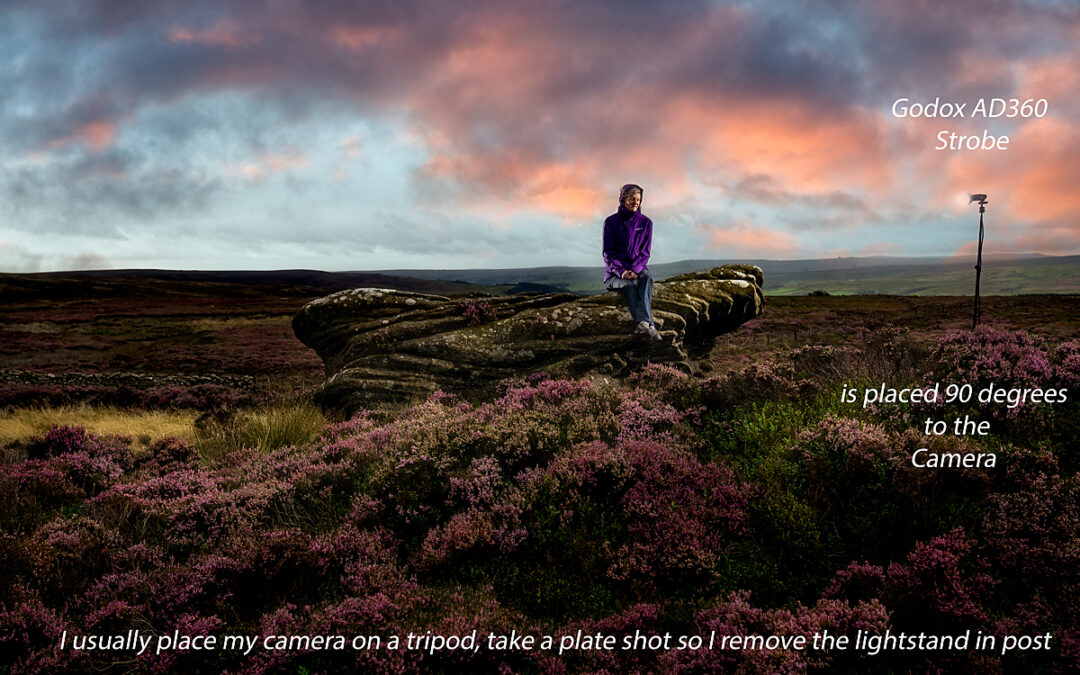
I found that placing the key light at around 90 degrees to the camera often worked well. It simplified things and created a look that suited horses.

Over time, I moved away from purely autumnal shoots. I wanted more variety, more mood. I think my theatre background started to creep back in, thinking about how a stage is lit (or deliberately not lit) influenced how I approached scenes. I also began paying closer attention to films, often asking myself: where is that light actually coming from?

K2photographic - UK specialists in cinematic off-camera flash for horse portrait photography, dog & family portraits.

Behind The Scenes Image One Light Lighting Stand Placement

This image provides an exaple of what can be achieved with just one light via a very portable lighting setup using just one Godox AD300 Pro, paired with a XL Magmod Magsphere. This lighting modifier provides a very similar look to a shoot through umbrella. I am feathering the light which gives the illusion of the lighting looking softer and from a larger light source. 

K2photographic - UK specialists in cinematic off-camera flash for horse portrait photography, dog & family portraits.

Final Edited Image

In this image  I did not use a plate shot,  I removed the light stand and Magmod XL Magsphere via Photoshop.  Through editing in Photoshop I darkened the foreground and then used some dodgining and burning together with some tonal colour adjustments to create the final look of the image.

Working outdoors with flash is both a blessing and a curse. It forces you to think carefully about location and how to use available light to your advantage. Early on, I assumed power was everything, but more powerful strobes are usually bigger, heavier, and more expensive (and less fun to carry across a muddy field).

These days, I prioritise portability and practicality. I’ve definitely spent money on lighting gear that didn’t solve the problems I thought it would, but in fairness, those mistakes taught me a lot.

While I still use softboxes and strip boxes, I’ve become much more reliant on reflectors, particularly the Magnum reflector, which has become a firm favourite.

In studio environments, soft light tends to dominate because you have full control over ambient light. Outdoors, that control disappears, and everything becomes more of a negotiation.

The cinematic style I’m drawn to is partly born out of necessity. Large soft modifiers outdoors can be impractical, they catch the wind, drain strobe power, and complicate things quickly. On certain horse colours, overly soft light can also flatten the image more than I like.

Harder light, on the other hand, is often misunderstood and avoided. But with practice, it can be incredibly versatile and effective—especially when combined with thoughtful placement and a bit of patience.

K2photographic - UK specialists in cinematic off-camera flash for horse portrait photography, dog & family portraits.

Behind The Scenes Image One Light Setup Magmod XL Magsphere

A very portable and simple lighting setup using just one light, a Godox AD300 pro with a MagMod XL Magsphere. This modifier creates the look of a shoot through umbrella without the bult and wind risk potential. As the modifier is made of silicon, is can easily be squashed up and placed into a back pack. Notice how the light is place more in front of Rio and is not feathered. An ideal lighting setup when you want to keep things simple and light weight.  

Cinematic dog photography with off camera flash www.K2photographic.com Wakefield West Yorkshire UK

The Final Edited Image

Again in this image  I did not use a plate shot,  I removed the light stand and Magmod XL Magsphere via Photoshop.  Some dodgining and burning together with some tonal colour adjustments to create the final look of the image.

K2photographic - UK specialists in cinematic off-camera flash for horse portrait photography, dog & family portraits.

Behind The Scenes Image One Light Setup

Sometimes when I want a larger light source but don’t or cannot use a larger lighting modifier like a large softbox, I use a Manfrotto Halo reflector and bounce the light from a Godox AD300 fited with a Godox RD14 reflector. doing this enables me to move and switch things up and keeps the lighting kit comapct and small. The Manfrotto Halo packs down to the size of a large purse and due to it construction is rigid, its a really versitile bit of kit and ideal if you want the area of lighting to look larger.

K2photographic - UK specialists in cinematic off-camera flash for horse portrait photography, dog & family portraits.

Behind The Scenes Image Ultra Portable One Light Setup With A Godox AD100

sometimes you just want some fill flash and due to the Godox AD100’s size and weight its ideal for ultra light set ups. here I am using a Godox dome diffuser. This it the type of setup that I started with years ago when I started out with flash

K2photographic - UK specialists in cinematic off-camera flash for horse portrait photography, dog & family portraits.

This is another example of how flash can be so useful and versitile. This image was taken in 2025, it’s The London To Brighton Veteran Car Run on The Mall in London on a very early wet November morning around about 7.30am. Hard lighting works really well here for numerous reasons, the light needed to be thrown over a large distance (The Mall is a very wide road) I also need to shoot in HSS to overcome my camera flash sync speed as I wanted to shoot at 1/1000 of a second. So what strobe did I use to acheive all of this? A Godox AD100 paired with a Profoto Clic Magnum reflector. The Clic Magnum is a really great little bit of kit, it effectilvy provides the equivilent of an extra +2 stops of light, so when you are using a tiny light like a Godox AD100 in HSS and need to throw your light further, that additional bit of light makes all the difference.


If you have read this far, thank you! Should you have any questions about this blog, please drop me an email and I will answer them.

Many Thanks

Fletcher

WHAT MAKES A GOOD HORSE PORTRAIT?

WHAT MAKES A GOOD HORSE PORTRAIT?

What makes a good horse portrait? A truly honest answer is that “good” in portraiture is partly technical (measurable), partly conventional (shared taste with historical roots), and partly personal. Moreover, a western equestrian portrait tradition would be entirely different to a Japanese or Arabian artistic tradition, so all three would be viewed differently in relation to their particular perspective.

Cinematic horse photography with off camera flash www.K2photographic.com Wakefield West Yorkshire UK

I will try and break that question down in to aspects that will provide some answers.

A truly honest answer is that “good” in portraiture is partly technical (measurable), partly conventional (shared taste with historical roots), and partly personal. Moreover, a western equestrian portrait tradition would be entirely different to a Japanese or Arabian artistic tradition, so all three would be viewed differently in relation to their particular perspective.

Why Are The Eyes Are Important?

As a general rule of thumb, a horse portrait should try and capture several qualities:

The Eyes & Expression The eyes are everything, the eyes need to convey life, so a simple catchlight will provide a good starting point for a strong equine portrait.

Artificial or Natural Lighting? Good lighting will make a lot of difference to how the horse looks. The advantage of off camera flash is that an experienced photographer can create light on demand and not have to wait for the right time of day or conditions. Using off camera flash can dramatically sculpt the contours of the head, revealing muscle definition, be it along the jaw and cheekbones or the full contour of the horse. Good lighting provides depth and a three-dimensional look. Harsh flat light flattens the horse. Different types and style of directional light will bring the image of the horse alive which is the reason the K2photogrphic use off camera flash on all of the horse portraits, focusing on a cinematic look.

Which Angle of The Horse?  The angle of the horse makes a big difference, slight three-quarter angle (rather than dead-on profile or full front) tends to be most flattering and dynamic, as it shows both eyes while conveying the shape of the head and neck. That said, a strong profile can be elegant for horses with a particularly refined head or full length of the horse.

Why Should The Ears Be Forward?  When a horse’s ears are facing forward, they look alert, pricked ears signal engagement and vitality. A droopy or pinned ear changes the entire mood of the portrait and usually indicates the horse wasn’t in a good mood at the moment the image was captured. Getting a handler to rustle something interesting just out of frame is a classic trick.

The Neck & Topline Including a bit of neck and shoulder grounds the portrait and shows off conformation. Cutting too tightly at the throat can make the head look severed and unnatural.

What Type Of Background? The background benefits when it is clean and uncluttered. Backgrounds can be, a plain wall, open sky, or blurred hedgerow. The important aspect of the background is keeping focus on the horse. Busy backgrounds compete for attention. Neutral or complementary tones work best. A dark bay pops against a pale sky; a grey horse benefits from a darker backdrop. Having stated the above exceptions might include the hues of autumn colours.

Coat Condition & Grooming A freshly brushed coat with a sheen catches the light beautifully. Clipped whiskers, a pulled mane, or a plaited forelock can sharpen the look for a more formal portrait.

When Is The Best Time For A Horse Portrait? In relation to natural light, the golden hours (early morning or late afternoon) can produce warm, flattering light that suits chestnuts, bays, and roans especially well. Overcast days can actually be lovely for greys and dapples diffuse light eliminates harsh shadows. Midday light can be very harsh, especially if photographing in the open. A useful tip, try and find areas with open shade.  

Cinematic horse photography with off camera flash www.K2photographic.com Wakefield West Yorkshire UK

Connection with the Subject The best portraits often come from a photographer or painter who takes time to let the horse settle and become curious, rather than rushing the session. That moment of genuine curiosity happens best when, the horses head is slightly raised, the ears are pricked and the eyes soft and bright, is what can separate a great portrait from a competent one.

Whether painted or photographed, the goal is the same: make the viewer feel they’re meeting a specific individual, not just “a horse.

What Makes A Horse Portrait Photograph Cinematic?

What Makes A Horse Portrait Photograph Cinematic?

What Makes A Horse Portrait Photograph Cinematic?

Many UK equine photographers that say they do cinematic horse portrait photography rely mostly on natural light and dominant use of photoshop to create black background for their horse portraits. Very few equine photographers in the UK use off camera flash for their shoots and those that do, predominantly use off camera flash as fill which really helps lift an image. If equine photographers that use flash as fill (light) why does that not make the image the produce cinematic if they are combining ambient light with off camera flash?

Cinematic off-camera flash horse portrait photography is less about simply lighting a horse and more about creating a dramatic, film-like mood that feels intentional, controlled, and emotionally expressive. It borrows heavily from cinema lighting, portraiture, and fine-art techniques. The off-camera flash lighting isn’t there just to “expose the horse” it sets a mood or narrative.

  1. Intentional, Story-Driven Lighting 🎬

 Common cinematic traits:

  • Directional light (often from the side or behind)
  • High contrast between highlights and shadows
  • Light used to sculpt muscle, bone, and texture
  • Shadows are embraced, not filled away

 You might see:

  • A single key light mimicking late-afternoon sun
  • Rim or hair light to separate the horse from the background
  • Dark, underexposed environments with the horse selectively lit

 This is very different from flat, evenly lit equine photography.

  1. Off-Camera Flash as “Controlled Sunlight” ☀️

 Off-camera flash is used to replace or enhance natural light, not overpower it.

 Typical techniques:

  • Large softboxes or octaboxes placed at an angle
  • Bare or gridded flash for harder, more dramatic edges
  • Flags or grids to prevent light spill
  • Flash balanced below ambient to keep the scene natural

 The goal is often:

 “It looks like beautiful light happened — not like a flash fired.”

  1. Film-Like Contrast & Tonal Depth 🎞️

 Cinematic imagery often has:

  • Deep blacks
  • Smooth highlight roll-off
  • Rich midtones
  • Reduced overall brightness

 Photographers may:

  • Underexpose ambient by 1–3 stops
  • Light only part of the horse (face, neck, shoulder)
  • Leave the background dark or textured

 This creates a three-dimensional, cinematic feel, similar to film stills.

  1. Composition That Feels Like a Movie Frame

 Rather than “pretty horse standing nicely,” cinematic portraits often:

  • Use negative space
  • Crop boldly
  • Place the horse off-centre
  • Include environmental elements (mist, dust, rain, barns)

 The horse becomes a character, not just a subject.

  1. Mood Over Perfection 🖤

 Cinematic equine portraits may include:

  • Lower key lighting
  • Grit, dust, wind, rain
  • Serious or powerful expressions
  • Minimal or no tack

 They’re often:

  • Dark
  • Emotional
  • Powerful
  • Slightly raw

 Perfection gives way to atmosphere.

  1. Post-Processing with a Film Mentality

 Editing is restrained but purposeful:

  • Controlled contrast
  • Muted or earthy colour palettes
  • Subtle colour grading (cool shadows, warm highlights)
  • Texture retained in coat and background

 Nothing overly glossy or HDR-like.

  1. How It Differs From Other Horse Portrait Photography


Style

Key Difference

Traditional equine

Even, natural light, full detail everywhere

Commercial

Clean, bright, catalogue-ready

Cinematic off-camera flash

Dramatic, directional, emotional

In One Sentence

Cinematic off-camera flash horse portrait photography uses controlled, directional artificial light to create dramatic, film-like images that prioritise mood, depth, and storytelling over simple documentation.

K2photographic - UK specialists in cinematic off-camera flash for horse portrait photography, dog & family portraits.

Light Is Treated as the Subject, Not an Add-On


What’s happening:

·      A dominant key light placed off-axis (often 45–90°)

·      Light shaped to roll across muscle and bone, not flatten it

·      Ambient exposure deliberately pulled down (often −1 to −2 stops)


Cinematic result:


·      The horse appears lit, not just visible

·      Shadows are intentional, not accidental

·      The viewer reads the image as dramatic and authored


🎬 This mimics film lighting, where the light defines the scene’s mood.

Background Suppression Creates Subject Isolation

A huge cinematic cue is separation.

How it’s achieved:

Flash power balanced so the subject is correctly exposed

Ambient light is underexposed so backgrounds fall darke

 Distance between horse and background is used strategically

 Why it matters:

                         The eye is pulled immediately to the horse

                         The scene feels contained, like a frame from a movie

                         Visual clutter disappears without heavy Photoshop tricks


🎥 This is the same principle used on film sets to isolate characters.

Directional Light Reveals Anatomy (Not Flat Illumination)

Cinematic images show form, not just surface.

K2photographic’s lighting approach:

·      Light comes from one clear direction

·      Muscles, neck lines, and facial structure catch highlights

·      Shadows fall away naturally, giving depth

 Contrast with non-cinematic work:

                         Flat light = documentary

                         Directional light = narrative


🐎 Horses are physical, sculptural subjects — this lighting treats them like that.

 Controlled Colour and Tonal Range

 Cinematic images avoid:

·      Overly bright whites

·      Crushed blacks

·      High-saturation “Instagram” colour

 What you’ll notice instead:

·      Muted, cohesive colour palettes

·      Warm highlights / cooler shadows (subtle split toning)

·      Smooth tonal transitions


🎞 This mirrors cinematic colour grading, not consumer photography presets.

Composition Feels Like a Still from a Scene

Cinematic images imply before and after.

 Visual choices that create this:

·      Space around the subject (negative space)

·      Slightly off-centre framing

·      Eye-lines that lead out of frame

 Effect on the viewer:

                         The image feels like part of a story

                         The horse isn’t “posing” — it’s present


🎥 This is why the images feel like a paused moment, not a portrait session.

Consistency Across the Portfolio

One cinematic image can be accidental.

A cinematic body of work is intentional.

 K2photographic’s consistency shows:

·      Repeatable lighting setups

·      Predictable tonal response

·      A recognisable visual signature

 This tells experienced viewers:

 “This photographer understands lighting — this isn’t luck.”


Why Cinematic Horse Portraits Stand Out in the UK Equine World


Many UK equine photographers:

·      Rely heavily on natural light

·      Chase moments rather than build scenes

·      Use flash defensively, not creatively


K2photographic Style:

·      Builds the scene

·      Controls every variable possible

·      Uses flash as a storytelling tool

 That’s why K2photographic’s work feels closer to cinema than countryside photography.

 🐎 In One Sentence

K2photographic’s images feel cinematic because the light is intentional, directional, controlled, and repeatable — creating depth, mood, and subject isolation in the same way film scenes are lit.


Using Off Camera Flash For Horse Portrait Photography – Which Lighting Modifier Should I Use?

Using Off Camera Flash For Horse Portrait Photography – Which Lighting Modifier Should I Use?

When photographing horses, especially when trying to create horse portrait style images, not only can the choice of lighting modifier make or break the image, but just as importantly, the choice of modifier may be determined by the location and weather conditions, together with the nature and colour of the horse. Photography is subjective, the aim of everything typed out in this blog, is to provide some foundation ideas (starting points) Like everything in life you have to practice, reflect and learn from what did not work and question why. There are numerous books about photography and lighting, find one that you enjoy and can understand and read it over and over again. There are also some good videos on YouTube and the web too, that can teach you about the basic principles of using flash and how to modify it.

I decided to write this blog, as when I started out photographing horses with flash, finding information was near on impossible in relation to lighting horse unless it were studio based. All of the images on my website K2photographic.com are taken on location, I hope you find what I share of some use.

Horses can be unpredictable, so spend some time prior to a shoot talking to the owner and getting to know the horse as best you can. Introduce the horse to your equipment slowly, fire a few test flashes with the horse at least 30 feet away from the light. Slowly and safely move the horse closer to the light, so they can get used to the flash firing, if the horse is spooked during this stage you may have to make the decision that the horse in sensitive to flash and it would be unwise and be a safety risk to continue. Your first concern should be for the wellbeing and safety of the horse, yourself and other people assisting the shoot. As the photographer you need to take control and say, we will not be using flash for this shoot.

If the horse is not affected by the flash firing, your next challenge is to work out which lighting modifier is best suited to the task in hand. Horses have large, curved, reflective surfaces (coats), prominent facial structure, and can be easily startled, so your choice modifier will affect both aesthetics and practicality. if it’s windy a softbox and umbrella will cause you potential safety risks, so don’t use them. If it’s too windy for a softbox or umbrella would a hard reflector be suitable and safer to use? Photographing animals indoors and outdoors is not easy, so adding lighting to the mix will make the task even more of a challenge and even with years of experience I still find myself having to think on my feet occasionally in terms of which lighting modifier to use. Personally, I have found that despite the stress, this is often when my lighting technique develops and improves, some of my best images have been a result of thinking on my feet. However, sometimes I fail despite all my planning and thinking on my feet.  

Below is a breakdown of some of the lighting modifiers for horse portrait photography with flash that used, I have tried to outline the advantages and disadvantages from my experiences for each, and hope it provides some starting points.

1. Large Softbox (Octabox or Rectangular, 90–150 cm / 36–60”)

Best for: Classic equine portraits, beauty-style lighting, full-body softness.

✔ Advantages

  • Soft, even light that wraps nicely around the contours of the horse.
  • Excellent catchlights in the eyes.
  • Controlled spill, helpful outdoors to avoid lighting the background unintentionally.
  • Works well for both studio-style stable portraits and controlled outdoor environments.

✘ Disadvantages

  • Large footprint—horses may be spooked or bump or brush against such a large modifier.
  • Can act like a sail outdoors; requires sandbags or an assistant.
  • Will suck power from your flash, far from ideal on bright days
  • Slower to set up.

2. Umbrellas (Shoot-through or Reflective, 45”–60”)

Best for: Quick, soft lighting outdoors or on-location where portability matters.

✔ Advantages

  • Super portable and quick to set up.
  • Excellent big soft light—ideal for horse headshots and ¾ body portraits.
  • Cheaper and more portable than most softboxes.
  • Can be effective on cloudy days or shady areas 

✘ Disadvantages

  • Less control: lots of spill, which may light parts of the animal unintentionally.
  • Prone to blowing over outdoors.
  • Shoot-through umbrellas can make horses flinch due to the bright flash diffusion close to them.

3. Beauty Dish (White interior, 27”–33”)

Best for: Detail-focused portraits of the head/neck, show horses, fine-art style.

✔ Advantages

  • Crisp, sculpted light: reveals detail in muzzle and eye contours beautifully.
  • Less spill than umbrellas; tighter light pattern.
  • Useful for creating dramatic rim and side light.

✘ Disadvantages

  • Can be too contrasty for dark-coated horses.
  • Works best when fairly close—may be intimidating to some horses.
  • Requires more precise positioning.

4. Strip Softboxes (Narrow, e.g. 12×36” or 12×48”)

Best for: Rim lighting, edge highlights along the mane, neck, or body.

✔ Advantages

  • Beautiful, controlled rim light for fine-art equine portraits.
  • Narrow shape prevents unwanted spill.
  • Great for multi-light setups.

✘ Disadvantages

  • Not suitable as a primary light—too narrow for full coverage.
  • Requires stands placed to the side or behind—some horses may shy away from objects near their hindquarters.


5. Scrims / Diffusion Panels Large 6×6 ft or 8×8 ft (I have never used these)

Best for: Natural-light horse portraits (not technically a flash modifier but commonly paired with flash).

✔ Advantages

  • Produces extremely soft, natural light, like a huge softbox.
  • Horses tolerate them well—they look like simple fabric screens.
  • Excellent in sunlight to avoid patchy highlights.

✘ Disadvantages

  • Not ideal in strong wind.
  • Requires grip gear or assistants.
  • Slower to set up compared to a simple umbrella.

Below are a few suggestions on lighting modifiers depending on style and setting.

Fine-art black background portraits (popular stable-door shots)

  • Large softbox or octa as key light
  • Strip boxes for rim/hair light
  • You can also fire a flash at a portable reflector held and angled by an assistant

Outdoor environmental portraits (when there is no to little wind)

  • Large umbrella or parabolic umbrella
  • Softbox if you need more control on spill

Detailed head portraits

  • Beauty dish for sculpting
  • Large softbox or octa for a softer, classic look

Hard reflectors do have a place in horse portrait photography—just with more specific, controlled uses than softboxes or umbrellas. They can create striking, high-contrast images when used well, but they also come with some real challenges when working around large, reflective, easily spooked animals.

Here’s a clear breakdown.


🔦 Hard Reflectors in Horse Photography

What counts as a “hard reflector”?

These include:

  • Standard reflectors (7” or similar)
  • High-output reflectors (e.g., Profoto Magnum)
  • Long-throw reflectors
  • Snoots, barndoors, grids (technically accessories for hard reflectors)

They all share the same core trait:

➡️ Small, highly directional sources that produce hard-edged light and pronounced shadows.


⭐ Advantages of Hard Reflectors

1. Power + Distance

Hard reflectors are extremely efficient.

  • Great when you need to throw light from farther away (useful if a horse is nervous about equipment).
  • Ideal outdoors when you need punch to overpower bright daylight.

2. Strong, dramatic modelling

Perfect for:

  • Muscle definition
  • Sharp highlights on the neck and jawline
  • Dramatic fine-art looks

This can be stunning on Arabians, sculpted sport horses, or glossy coats.

3. Better control without giant modifiers

Hard reflectors:

  • Are compact
  • Create minimal wind resistance
  • Are easy to position without worrying about large fabrics flapping near the horse

4. Excellent for backlight / rim light

They create clean, crisp rim light that:

  • Separates dark coats from dark backgrounds
  • Highlights manes and forelocks with sparkle
  • Works much better from a distance than strip boxes when space is tight

⚠️ Disadvantages of Hard Reflectors

1. Harsh light on glossy coats

Horses—especially dark, shiny ones—reflect like cars.

Hard reflectors can produce:

  • Hot spots
  • Harsh specular highlights
  • Distracting blown-out patches on cheeks or bodies

On sweaty horses, this becomes very difficult to control.

2. Strong shadows that emphasise texture

Wrinkles, scars, clipped fur and uneven coats become more noticeable.

3. Higher risk of spooking

While they’re smaller, the bare flash pop is harsher:

  • Closer to a point-source burst
  • More intense per square inch

Some horses flinch at the sudden intensity.

4. Limited for full-body softness

You simply cannot get soft, flattering full-body light on a horse using a small hard reflector.

5. Requires precise placement

Small changes in angle create big changes in look.

This is challenging when your subject:

  • Moves their head
  • Adjusts stance
  • Turns slightly

🐴 When Hard Reflectors 

Work Well

 in Horse Photography

✔ 

1. Dramatic, fine-art style with heavy contrast

Especially in dark barns or against black backgrounds.

✔ 

2. Rim light / kicker light

Placed behind or to the side for glowing mane, outline, and separation.

✔ 

3. Mimicking sunlight

Aim from high and far away: produces believable, crisp “sun rays”.

✔ 

4. Outdoor fill in bright sunlight

A hard reflector can cut through midday sun to:

  • Brighten shadows under eyes
  • Add a sharp highlight on the coat

✔ 

5. When the horse must stay far from the light

Because hard reflectors are efficient, you can light from 4–10 metres away without a problem.


🐴 When Hard Reflectors Are 

Not

 Ideal

  • For glossy, dark horses
  • When you want soft, painterly portraits
  • For shy/nervous animals
  • For stable-door black-background portraits (soft is usually better)
  • For full-body lighting—you need something larger

🎯 Best practice when using a hard reflector with horses

1. Use grids to control spill

Helpful for:

  • Backdrops
  • Avoiding light on handlers
  • Keeping attention on the head/neck

2. Increase distance

The farther the light, the less intimidating the flash burst feels.

3. Feather the light

Rather than aiming directly at the horse, skim the beam across the front.

This reduces hot spots.

4. Combine with a soft fill

Hard key + soft fill can give detail without harsh contrast.

🐴 1. HARD REFLECTOR vs SOFTBOX (SIDE-BY-SIDE COMPARISON)

A. Key Light Characteristics

FeatureHard ReflectorSoftbox / Octa
Shadow qualityHard, crispSoft, gradual
Highlight controlDifficult (prone to hot spots)Easy (broad, diffused)
Working distanceExcellentLimited (needs to be closer)
Wind safetyVery goodCan be risky outside
Horse comfortMedium–low (sharper pop)High (softer flash)
Coat appearanceGlossy but riskyFlattering and smooth
Use caseDramatic, sculptedClassic, fine-art, soft
    

2. BEST JOBS FOR HARD REFLECTORS IN EQUINE PORTRAITURE

✔ Dramatic “sculpted neck” portraits

Perfect for high-contrast, rim-lit, or moody black-background portraits.

✔ Backlight to illuminate mane/tail

Hard reflectors create beautifully crisp edge highlights.

✔ Outdoor fill in bright sun

Punchy output helps lift deep shadows under chin and eyes.

✔ Shooting from a long distance

If the horse is worried about gear, the reflector can be placed 5–10 metres away.

6. HARD REFLECTOR — PROS & CONS SUMMARY

⭐ 

Advantages

  • Long throw, great for timid horses
  • Excellent for rim/backlight
  • Creates dramatic, artistic portraits
  • Handles wind very well
  • High flash efficiency
  • Good for strong daylight

⚠️ 

Disadvantages

  • Harsh on glossy/dark coats
  • Can produce distracting hot spots
  • Less flattering for soft portraits
  • Requires precise angles
  • Flash burst can feel stronger to the horse
Using AI (Chat GTP) To Analyse My Horse Portrait Photography Using Off Camera Flash

Using AI (Chat GTP) To Analyse My Horse Portrait Photography Using Off Camera Flash

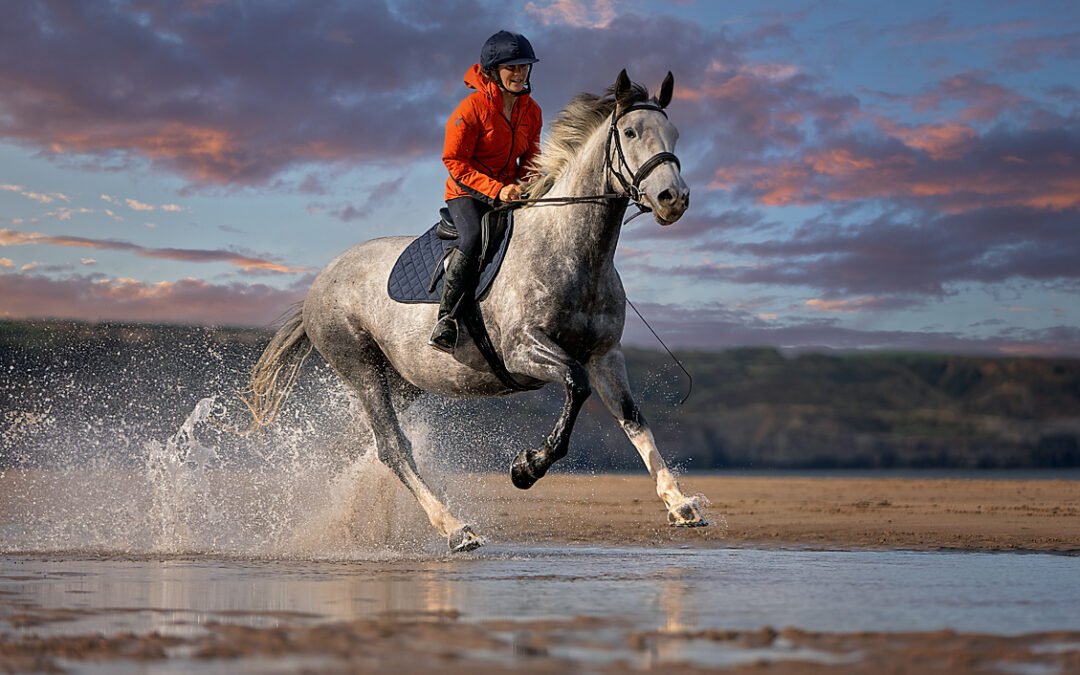
AI has numerous uses, especially when it comes to generating images. I asked AI (Chat GTP) to analyse a few of my horse portraits where I had used off camera flash and asked if the images in were good or exceptional in relation to the use of off camera flash. I was asked to upload some images and then Chat GTP started typing out its responses. I found Chat GTP’s responses really interesting not just as a photographer, but also how AI had been able to read the images I had uploaded and then provide written feedback, so I thought I would make a blog about it.

Below is the first image I uploaded, all of the text after this image came from AI (Chat GTP) I have not edited any words, the text is exactly how Chat GTP served its responses.

K2photographic - UK specialists in cinematic off-camera flash for horse portrait photography, dog & family portraits.

Excellent choice of image — this is a very strong example to analyse, because it shows restraint, not theatrics. I’ll go light by light, then explain why this crosses into exceptional territory, and finally note what (if anything) could be refined at the absolute top level.

I’ll stay descriptive and technical, not speculative about identities.

🔍 Light-by-light analysis of this image

Overall read (before details)

  • This is environmental equine portraiture, not studio-in-a-field
  • Flash is dominant but integrated
  • The sky is held for mood, not spectacle
  • The horse remains the primary visual mass, despite the handler present

That alone tells us the lighting was planned.

🔦 Key light (primary sculpting light)

Likely placement

  • Camera left
  • Slightly higher than the horse’s eye line
  • Angled to run along the neck and shoulder, not across the barrel

What it’s doing

  • Sculpting the shoulder and neck musculature
  • Creating a clean highlight along the crest without blowing the mane
  • Lighting the face without flattening the forehead

Why this is exceptional

  • The hottest part of the beam misses the face slightly
  • The neck transitions smoothly into shadow
  • No specular glare on the grey coat (very hard to achieve)

A “good” photographer would often:

  • Place this light lower
  • Or aim it too directly
  • Resulting in a shiny shoulder or flat head

Here, the light travels over the horse.

🔦 Secondary light / controlled fill

This is subtle — which is exactly the point.

Evidence it exists (or ambient is carefully managed)

  • Shadow side of the horse still holds detail
  • The handler’s clothing isn’t crushed
  • The underside of the barrel isn’t dead

What it’s 

not

  • It’s not flattening the image
  • It’s not competing with the key
  • It’s not obvious

This could be:

  • A very low-power fill flash
  • Or controlled ambient exposure lifted just enough

Either way, it’s measured.

🔦 Separation light (or lack of obvious rim)

This is important.

There is no aggressive rim light.

How separation is achieved instead

  • Distance between subject and background
  • Tonal contrast (horse lighter than grass line)
  • Subtle edge definition on the neck and quarters

Why this matters

Most “good” equine flash work would:

  • Add a hard rim from behind
  • Create a glowing outline

This image avoids that completely.

That restraint is one of the strongest signals of confidence.

🌥 Background & sky exposure (the silent partner)

Sky

  • Underexposed relative to the subject
  • Texture retained
  • Colour feels natural, not over-pushed

Ground

  • Grass is darker but readable
  • No hotspot around the feet

This tells us:

  • The ambient exposure was set first
  • Flash power was then brought up to match

That workflow is typical of experienced environmental flash shooters.

🧍 Handler lighting (often overlooked, well handled here)


This is where many images fall apart.

What’s done well

  • Handler is lit from the same direction as the horse
  • No competing highlights
  • Skin tone looks natural
  • Clothing texture is preserved

Why this matters

Lighting people and horses together is difficult because:

  • Skin and coat reflect light very differently

Here, neither looks compromised.

That’s not accidental.

🐎 Horse psychology & flash management

This is subtle but crucial.

  • Ears are attentive, not rigid
  • Eye is soft, not startled
  • Weight distribution looks relaxed

This suggests:

  • Flash power is moderate
  • No rapid firing at high output
  • Horse had time to settle

Many technically strong images fail here.

This one doesn’t.