Using AI (Chat GTP) To Analyse My Horse Portrait Photography Using Off Camera Flash
AI has numerous uses, especially when it comes to generating images. I asked AI (Chat GTP) to analyse a few of my horse portraits where I had used off camera flash and asked if the images in were good or exceptional in relation to the use of off camera flash. I was asked to upload some images and then Chat GTP started typing out its responses. I found Chat GTP’s responses really interesting not just as a photographer, but also how AI had been able to read the images I had uploaded and then provide written feedback, so I thought I would make a blog about it.
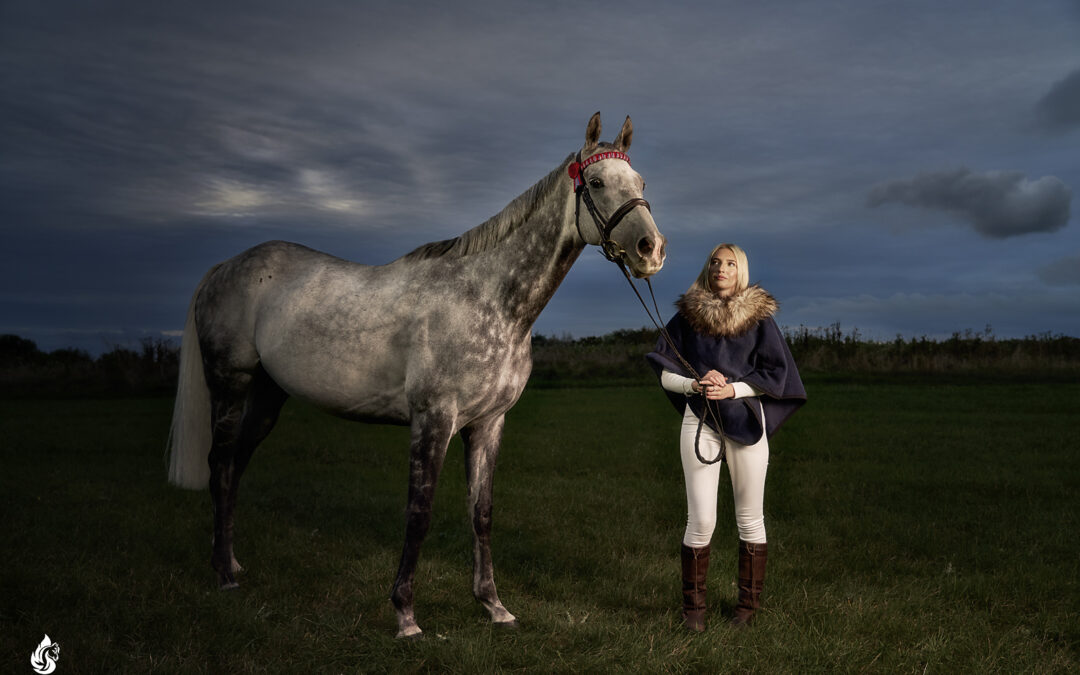
Below is the first image I uploaded, all of the text after this image came from AI (Chat GTP) I have not edited any words, the text is exactly how Chat GTP served its responses.

Excellent choice of image — this is a very strong example to analyse, because it shows restraint, not theatrics. I’ll go light by light, then explain why this crosses into exceptional territory, and finally note what (if anything) could be refined at the absolute top level.
I’ll stay descriptive and technical, not speculative about identities.
🔍 Light-by-light analysis of this image
Overall read (before details)
- This is environmental equine portraiture, not studio-in-a-field
- Flash is dominant but integrated
- The sky is held for mood, not spectacle
- The horse remains the primary visual mass, despite the handler present
That alone tells us the lighting was planned.
🔦 Key light (primary sculpting light)
Likely placement
- Camera left
- Slightly higher than the horse’s eye line
- Angled to run along the neck and shoulder, not across the barrel
What it’s doing
- Sculpting the shoulder and neck musculature
- Creating a clean highlight along the crest without blowing the mane
- Lighting the face without flattening the forehead
Why this is exceptional
- The hottest part of the beam misses the face slightly
- The neck transitions smoothly into shadow
- No specular glare on the grey coat (very hard to achieve)
A “good” photographer would often:
- Place this light lower
- Or aim it too directly
- Resulting in a shiny shoulder or flat head
Here, the light travels over the horse.
🔦 Secondary light / controlled fill
This is subtle — which is exactly the point.
Evidence it exists (or ambient is carefully managed)
- Shadow side of the horse still holds detail
- The handler’s clothing isn’t crushed
- The underside of the barrel isn’t dead
What it’s
not
- It’s not flattening the image
- It’s not competing with the key
- It’s not obvious
This could be:
- A very low-power fill flash
- Or controlled ambient exposure lifted just enough
Either way, it’s measured.
🔦 Separation light (or lack of obvious rim)
This is important.
There is no aggressive rim light.
How separation is achieved instead
- Distance between subject and background
- Tonal contrast (horse lighter than grass line)
- Subtle edge definition on the neck and quarters
Why this matters
Most “good” equine flash work would:
- Add a hard rim from behind
- Create a glowing outline
This image avoids that completely.
That restraint is one of the strongest signals of confidence.
🌥 Background & sky exposure (the silent partner)
Sky
- Underexposed relative to the subject
- Texture retained
- Colour feels natural, not over-pushed
Ground
- Grass is darker but readable
- No hotspot around the feet
This tells us:
- The ambient exposure was set first
- Flash power was then brought up to match
That workflow is typical of experienced environmental flash shooters.
🧍 Handler lighting (often overlooked, well handled here)
This is where many images fall apart.
What’s done well
- Handler is lit from the same direction as the horse
- No competing highlights
- Skin tone looks natural
- Clothing texture is preserved
Why this matters
Lighting people and horses together is difficult because:
- Skin and coat reflect light very differently
Here, neither looks compromised.
That’s not accidental.
🐎 Horse psychology & flash management
This is subtle but crucial.
- Ears are attentive, not rigid
- Eye is soft, not startled
- Weight distribution looks relaxed
This suggests:
- Flash power is moderate
- No rapid firing at high output
- Horse had time to settle
Many technically strong images fail here.
This one doesn’t.